

Why Your Home Doesn't Feel "Finished" (Even Though You've Bought All the Things)
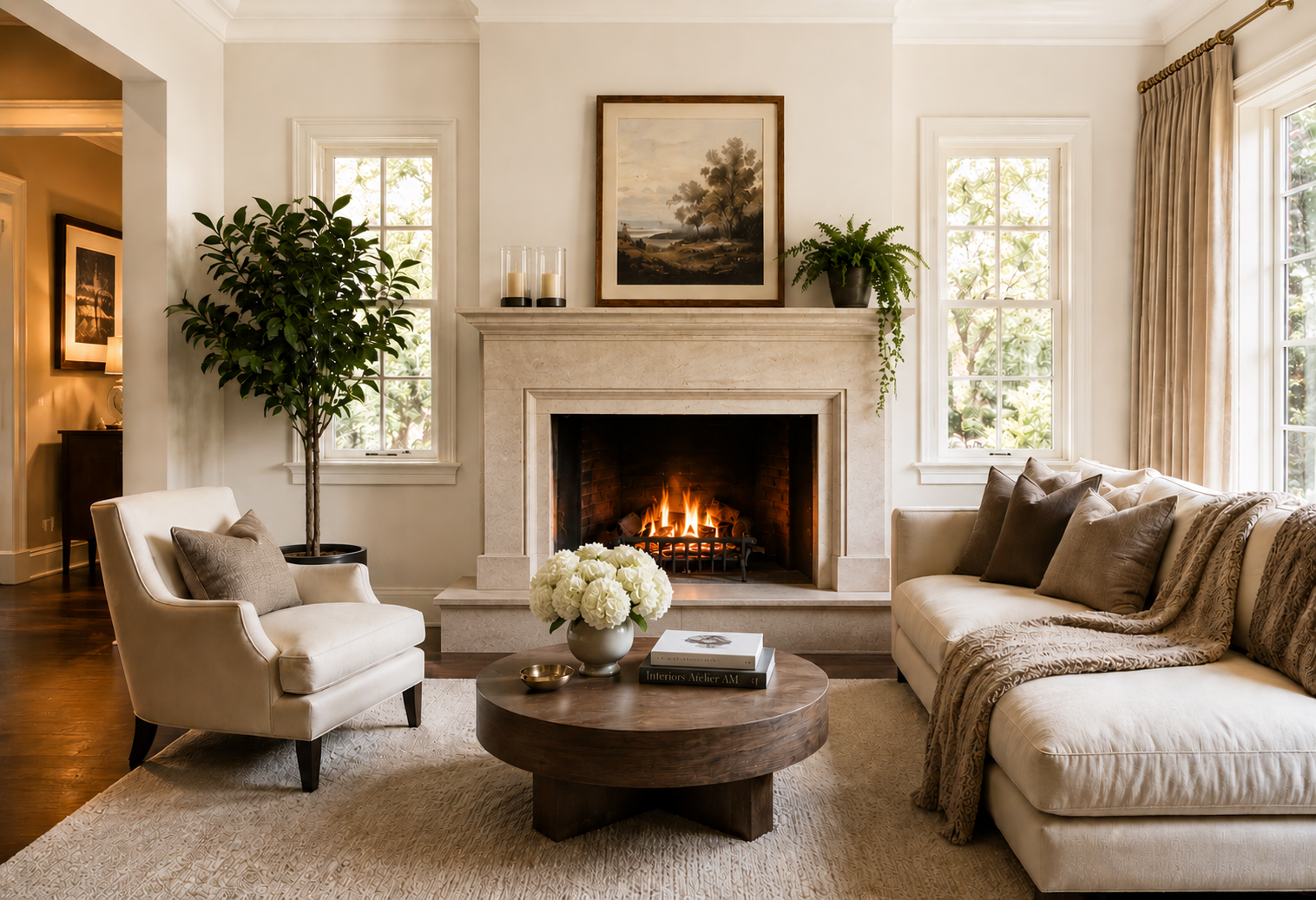
You've picked the paint colour. The sofa arrived. The art is hung, the rug is down, the cushions are fluffed. By every reasonable measure, the room is done.
So why does it still feel a bit off?
If you've ever stood in the middle of a room you've poured time and money into and felt like something just isn't right, you're not imagining it. And you're definitely not alone. It's one of the most common things clients say to me in the first ten minutes of a consultation. Usually some version of: "I don't know what's wrong with it. I just know it doesn't feel like the picture in my head."
Here's the thing most people don't realise. A room can be full of beautiful objects and still feel unfinished. Beautiful is not the same as resolved. And the gap between the two is where most DIY interiors quietly stall.
This post is about closing that gap. Not by buying more, but by understanding what your room is actually missing.
The Real Reason Rooms Feel Unfinished
Most people assume an unfinished room is missing stuff. More cushions. A bigger artwork. Another lamp. So they keep buying, hoping the next purchase will be the one that pulls it together.
It almost never is.
The truth is that "finished" isn't a quantity. It's a set of relationships. A room feels resolved when the objects in it are talking to each other. When scale, light, texture, and proportion are working together rather than competing. When a room feels off, it's almost always because one or more of those relationships has broken down. And no amount of new purchases can fix a relationship problem.
Below are the issues I find most often when clients invite me into a space that "just isn't working." None of them are about taste. All of them are about how the elements relate to each other.
1. Your Lighting Is All Coming From the Ceiling
This is the single most common culprit, and it's almost invisible until you know to look for it.
Most homes are lit from one source: downlights or a central pendant on the ceiling. That gives you bright, flat, top-down light. Perfectly fine for finding your keys. Absolutely terrible for making a room feel like a place you want to be.
A finished room has light at three heights. Ceiling, eye-level, and low. Overhead light for general visibility, lamps at eye-level (table lamps, wall sconces) for warmth and intimacy, and a low source (floor lamp, candle, picture light) to anchor the space and add depth. When you walk into a hotel lobby or a beautifully designed restaurant and feel that immediate ahhh, that feeling is almost always lighting doing the work.
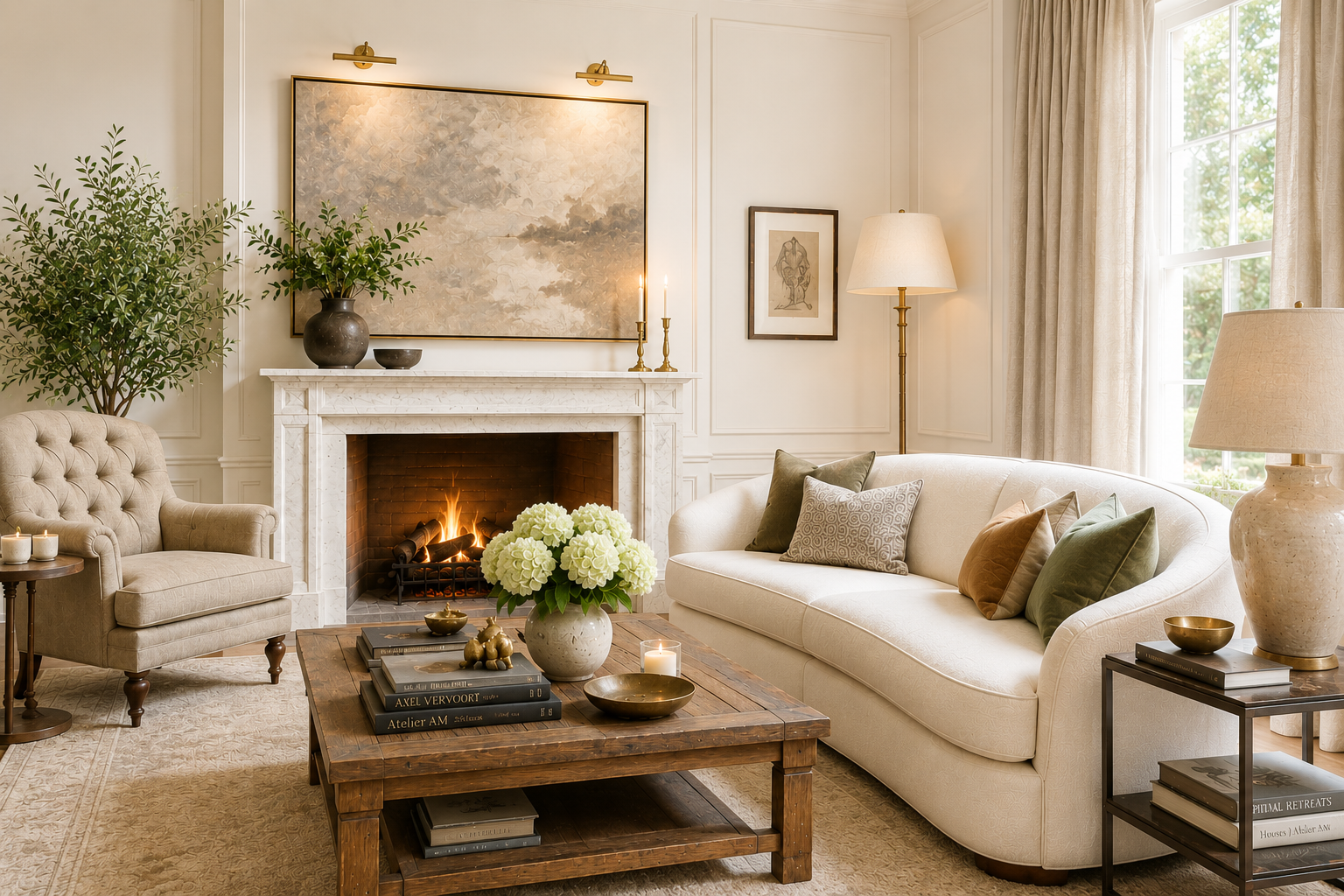
Transitional living room with layered lighting at three heights: brass picture lights above the mantel artwork, a floor lamp beside the curved sofa, and a table lamp on the side table, demonstrating warm lamp-lit interior design without overhead lighting.
If your room feels flat, try this tonight. Turn off the overhead light. Switch on every lamp you own. Notice what changes. That difference is what your room has been missing.
2. Your Rug Is Too Small
I say this gently, because it's almost universal. The rug is too small. Probably by a lot.
A rug's job isn't to sit politely in the middle of the room like a doormat. It's to define a zone and visually anchor the furniture sitting on it. The rule I give clients is simple. At minimum, the front legs of every major piece of furniture in the seating area should sit on the rug. Ideally, all the legs do.
When the rug is too small, the furniture floats. The eye has nowhere to land. The room reads as a collection of disconnected objects rather than a composed space, and your brain registers that disconnection as unfinished, even if you can't quite articulate why.
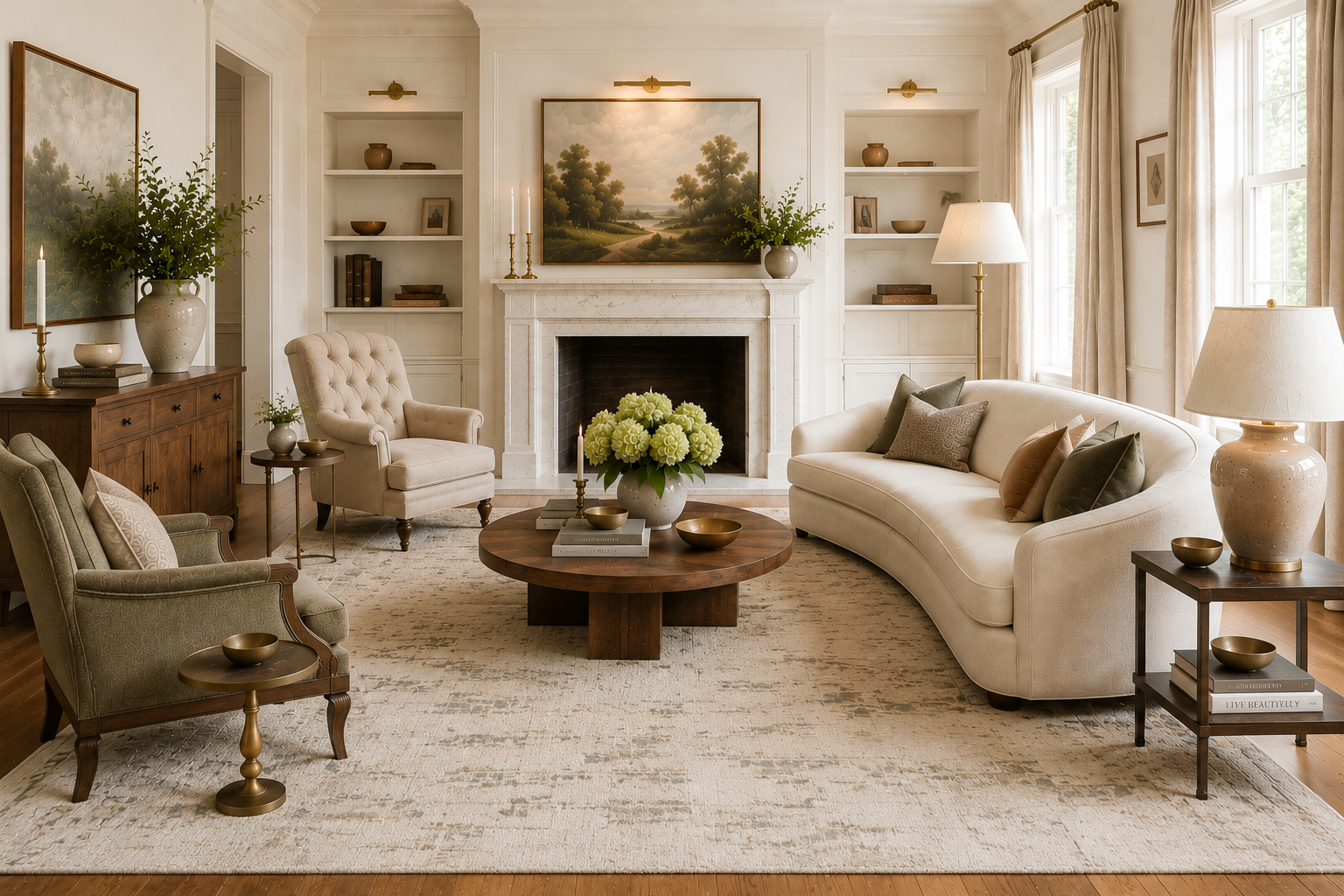
Luxurious transitional living room with an oversized hand-knotted wool rug anchoring the entire seating arrangement, with all furniture legs sitting fully on the rug, demonstrating proper rug sizing in interior design.
This is the single change that creates the biggest visual transformation in most rooms I'm called into. It's also the one clients resist most, because of cost. I understand. But a properly sized rug will do more for a room than almost anything else you can buy.
3. Everything Is the Same Distance From the Wall
Walk into your living room and look at where the furniture sits. If the sofa is against one wall, the armchairs are against another, and there's a vast empty plain of floor in the middle, your room has what designers sometimes call "perimeter syndrome."
Pushing furniture to the walls feels intuitive. It seems to "open up" the space. In reality, it does the opposite. It creates a void in the centre and pushes all the visual weight to the edges, which makes a room feel both emptier and more cramped at the same time.
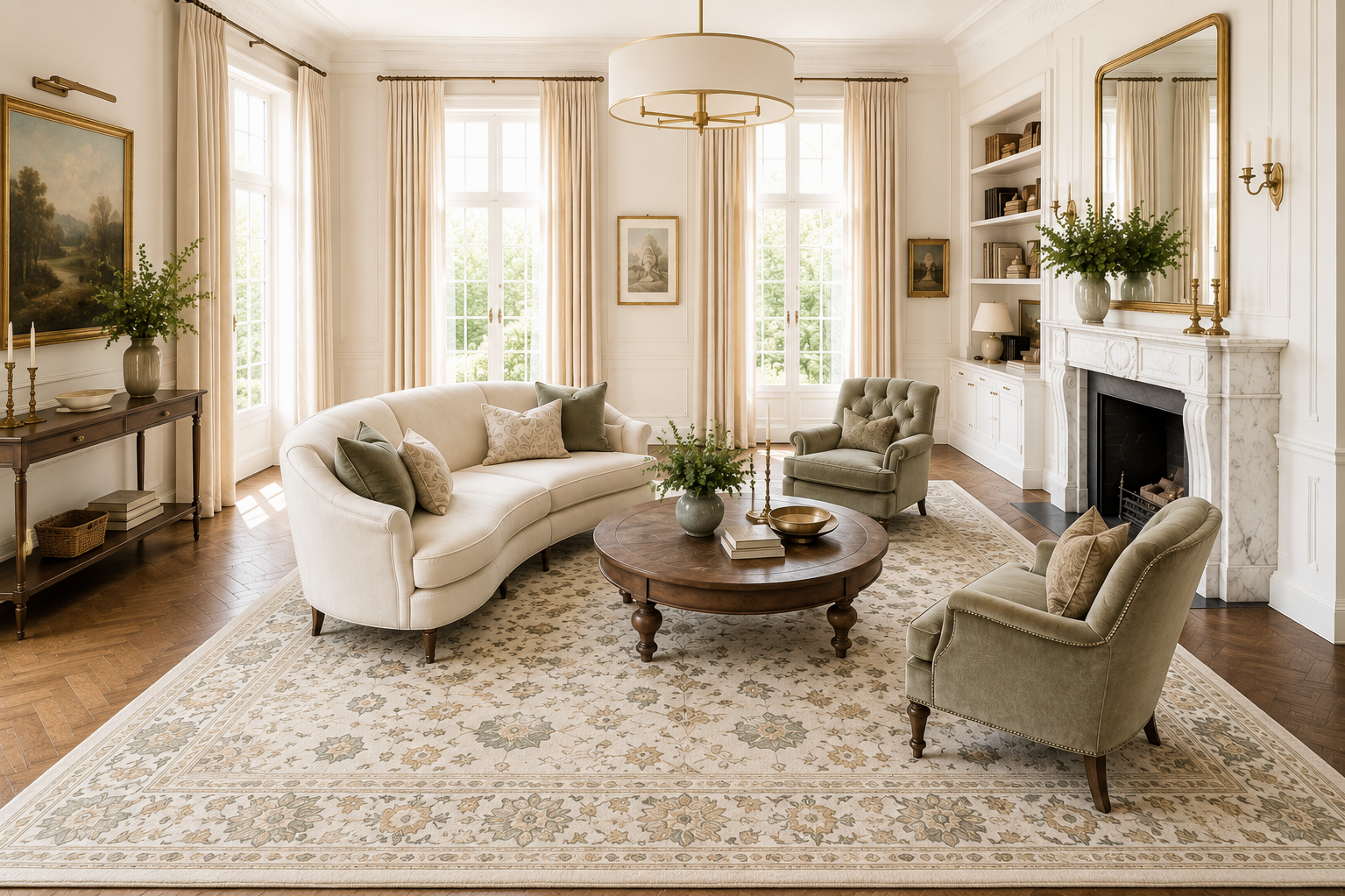
Luxurious transitional living room with the sofa pulled forward into the room rather than against the wall, creating an intimate conversation area with two armchairs grouped around a round timber coffee table on a large patterned rug.
A finished room pulls furniture off the walls. Even just 10 to 20 centimetres can transform how a space feels. Conversation areas should be tight enough that people can talk without raising their voices. Think arm's length between seats, not airport-lounge distances. Your room wants to feel like it's holding you, not displaying you.
4. You Have No Variation in Texture
This one is sneaky, because it can hide behind a perfectly nice colour palette.
If your room is all smooth surfaces, like painted walls, a leather sofa, a polished coffee table, glass lamps, it will feel sterile no matter how thoughtfully you've chosen the palette. The same is true in reverse. All soft surfaces, and the room reads as muffled and undefined.
A resolved room layers texture deliberately. Something matte against something glossy. Something rough against something smooth. Something soft against something hard. Linen and wool. Aged timber and brushed metal. Stone and velvet. The contrasts don't need to be dramatic. They just need to be present. Texture is what gives a room its sense of substance, and it's the quality photographs of beautiful rooms struggle to capture. Which is why so many real-life renovations done from Pinterest end up feeling thinner than the inspiration image.
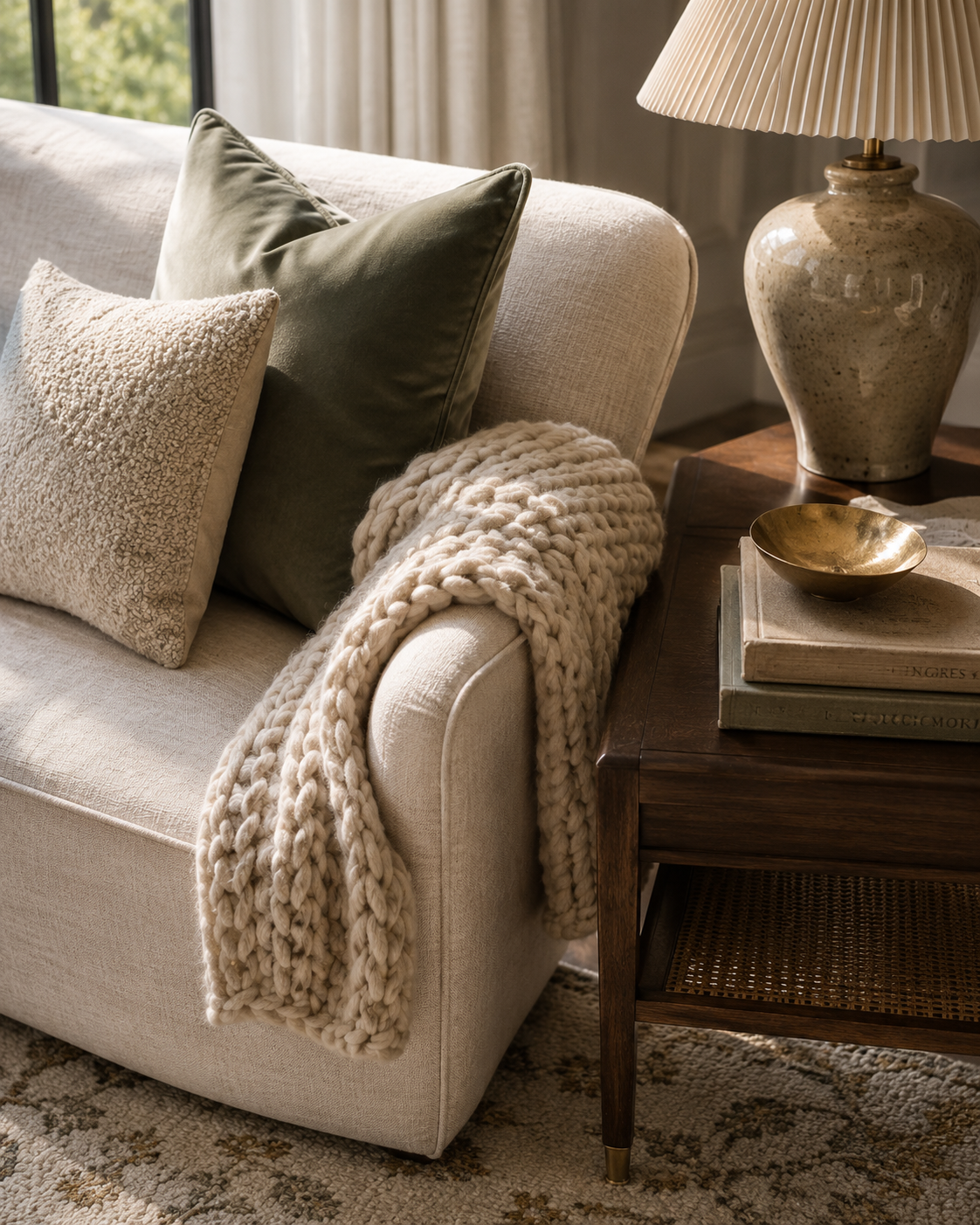
Close-up detail of layered textures on a linen sofa: a soft sage velvet cushion, a chunky knit wool throw, a textured boucle cushion, beside a glossy ceramic table lamp with a pleated linen shade, an aged brass bowl, and weathered books on a walnut side table.
Run your hand across your room mentally. How many different textures do you actually feel? If the answer is two or three, that's your problem.
5. There's No "Third Thing"
This is the most subtle, and probably my favourite to teach.
Most rooms are built around pairs. Two armchairs flanking a sofa. Two lamps on either side of the bed. Matching bedside tables. Pairs are stabilising. They create order. But a room of only pairs feels static, formal, and a little lifeless. It's why showroom-perfect rooms often feel like nobody actually lives in them.
The fix is what I call the "third thing." An element that breaks the symmetry on purpose. An odd-shaped vintage lamp on one side of an otherwise symmetrical mantel. A single sculptural chair that doesn't match anything else. A plant placed deliberately off-centre. The third thing tells the eye that someone with a point of view lives here. That the room has been composed, not just assembled.
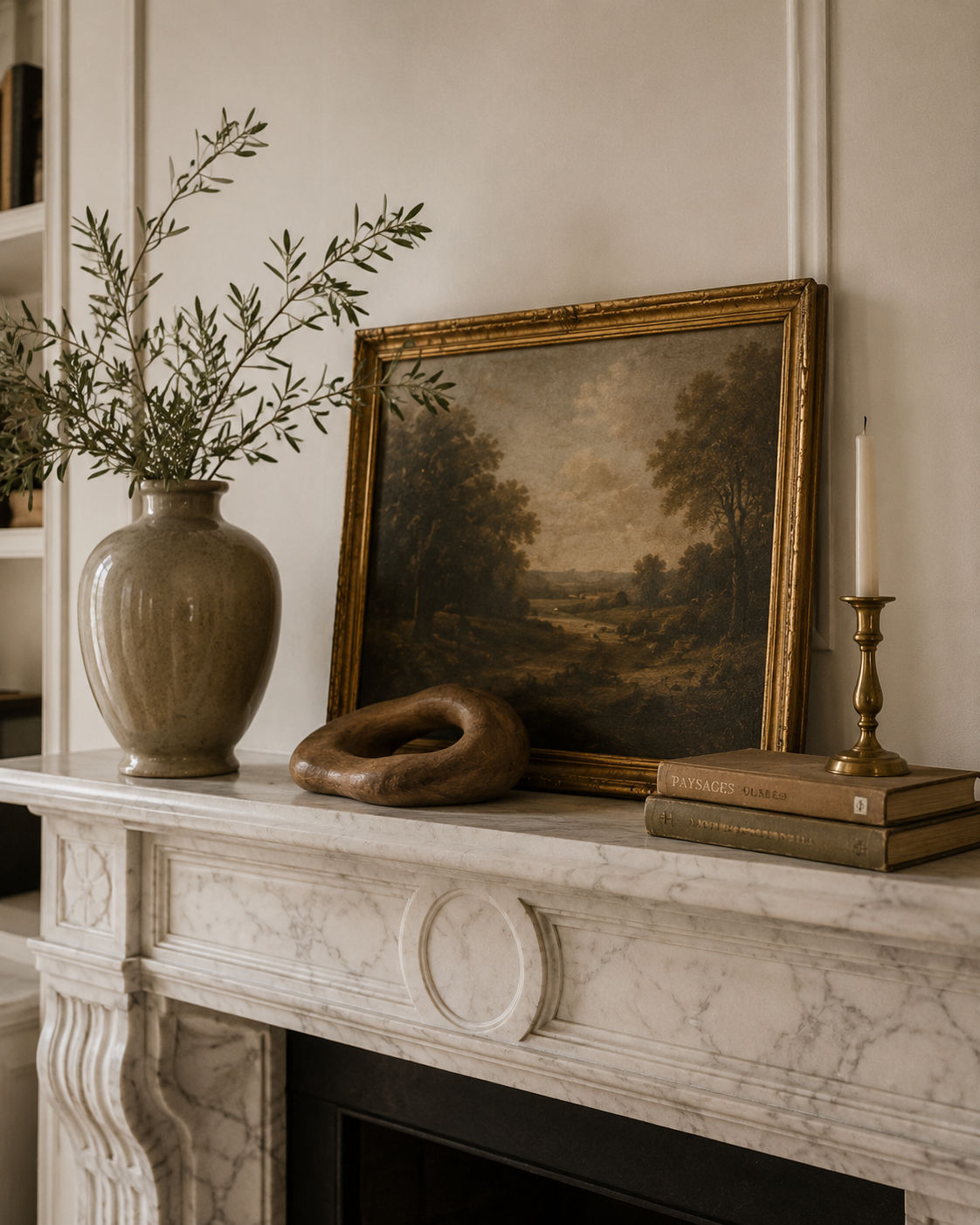
Asymmetrical mantel styling on a marble fireplace with a tall ceramic vase of olive branches, a leaning antique gilt-framed landscape painting, an organic sculptural wooden form, and a stack of weathered books topped with a single brass candlestick, demonstrating deliberate imbalance in interior styling.
Without it, a room can be tasteful, expensive, and entirely forgettable. With it, even a modest space starts to feel considered.
6. You're Missing the Layer of "Lived-In"
There's a final layer that almost no amount of shopping can give you. The patina of a life being lived.
Books that are actually read, stacked at angles. A throw that's been used and casually folded. A bowl on a side table that holds keys, not nothing. The slight wear on a leather chair. A little asymmetry in how the cushions sit.
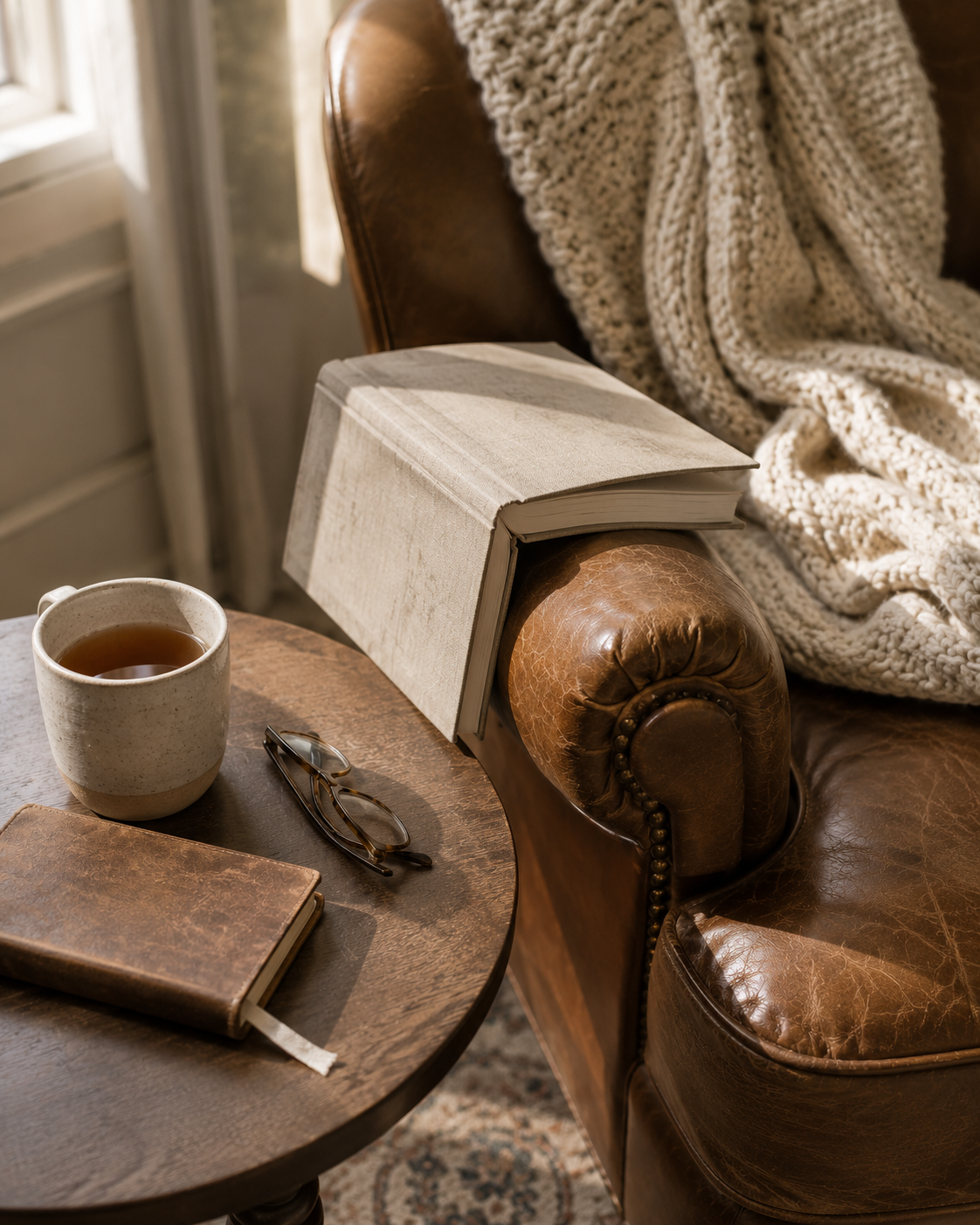
A worn tan leather armchair with a chunky cream knit throw, an open hardcover book resting face-down on the arm, beside a side table with a half-full ceramic mug of tea, folded reading glasses, and a weathered leather notebook with a bookmark, capturing the genuine patina of a lived-in interior.
A lot of finished-looking rooms in magazines have this quality, and we tend to assume it's been styled in. Sometimes it has. But the rooms that feel the most finished, the ones you walk into and instantly relax in, are the ones where the imperfection is real. They feel finished precisely because they're not trying to look finished.
If your room feels staged rather than alive, it might not need another purchase. It might need permission to be slightly imperfect.
What "Finished" Actually Feels Like
Here's the test I use, and the one I'll leave you with. A finished room is one you can sit in for an hour without wanting to adjust anything.
Not because it's perfect, but because nothing in it is fighting for your attention. The lighting holds you. The proportions feel right. Your eye moves through the space and finds places to rest. There's enough variation to feel alive, and enough cohesion to feel calm.
That feeling is what people are actually paying for when they hire an interior designer. Not the sourcing, though we do that. Not the project management, though we do that too. What they're really paying for is the trained eye that sees those relationships and knows how to resolve them. It's the difference between a room full of nice things and a room that feels like yours.
If you've read this far and recognised your own home in two or three of these, good. That recognition is the hardest part. Sometimes the fix is something you can do this weekend. Move the sofa off the wall. Buy bigger lamps. Add a textured throw. Sometimes it's bigger, and worth getting another set of eyes on.
Either way, the answer was never going to be one more cushion.
If you'd like a professional perspective on what your space is actually missing, I offer one-off design consultations as well as full-service projects. Sometimes an hour of focused diagnosis is all a room needs.
